


Metro Vancouver Construction Costs Have More Than Doubled Since 2014
New research from UDI and Altus Group, examines how residential construction costs in Metro Vancouver changed between 2014 and 2025.
UDI and Altus Group compared direct construction costs for three hypothetical residential projects in Burnaby, Vancouver and Surrey. The study found that costs more than doubled across all three building types between 2014 and 2025, with increases ranging from approximately 104% to 112%.
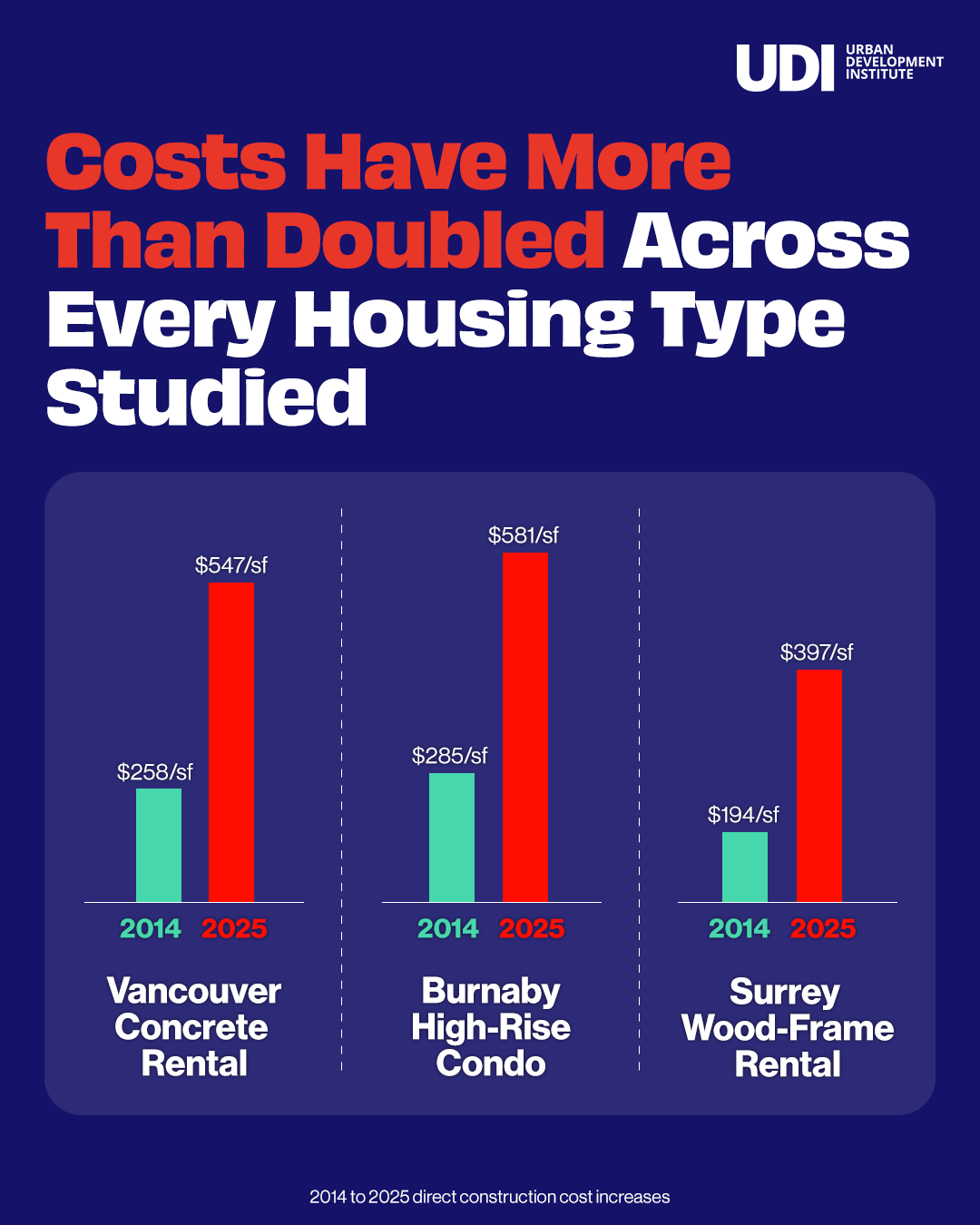
Construction costs in Metro Vancouver: 2014 vs. 2025
Altus Group's estimates show substantial increases across all three residential building types studied.
Direct construction costs more than doubled for every residential building type Altus Group studied.
Vancouver concrete rental construction costs increased by approximately 112%, from $258 per square foot in 2014 to $547 per square foot in 2025, an increase of $289 per square foot.
Burnaby high-rise condo construction costs increased by approximately 104%, from $285 to $581 per square foot, an increase of $296 per square foot.
Surrey wood-frame rental construction costs increased by approximately 105%, from $194 to $397 per square foot, an increase of $203 per square foot.
What is included in Metro Vancouver construction costs?
Altus Group's Class C estimates include direct construction costs, general requirements, and contractor overhead and profit.
The estimates do not represent the total cost of delivering a new home. The study excludes land, financing, professional fees, legal fees, marketing, realty taxes and levies, operating expenses, GST and several other development and construction costs. PST is included where applicable.
What has increased condo and apartment construction costs in Metro Vancouver?
Altus Group identified several overlapping factors that contributed to higher construction costs between 2014 and 2025, including material prices, labour costs, building performance requirements and regulatory changes.
Material and labour costs
Altus Group found that key Metro Vancouver residential construction materials increased significantly between 2014 and 2025. Rebar increased approximately 150% to 200%, lumber increased approximately 60% to 120%, and concrete increased approximately 40% to 65%.
Its labour comparison uses Statistics Canada's Construction Union Wage Rate Index for Vancouver, which increased 33.8% between 2014 and 2025. The index measures unionized construction labour and does not include material costs or most contractor overhead and profit.
For comparison, Altus Group reports that general inflation increased 29.28% between 2014 and 2025.
Building code and performance requirements
Altus Group found that changes to building code and performance requirements added incremental costs to condo and apartment construction in Metro Vancouver between 2014 and 2025. These included changes related to energy efficiency, seismic requirements, accessibility and adaptable units, cooling requirements and the Zero Carbon Step Code.
These figures represent typical incremental cost increases associated with individual code and performance requirements, not total construction inflation. They should not be added together to calculate a cumulative increase.
Soil classification and disposal costs
Altus Group found that changes to soil classification, testing and disposal requirements have added another source of cost pressure, particularly for projects involving deep excavations.
Typical high-rise sites in Vancouver and Burnaby can now incur $70,000 to $100,000 in soil sampling costs alone before disposal or remediation. Altus estimates that soil-related costs have risen approximately 10% to 30% between 2014 and 2025, depending on soil conditions, previous land use and excavation volume.
What did the Altus Group Metro Vancouver construction cost study examine?
Altus Group compared direct construction costs in 2014 and 2025 using three hypothetical residential projects: a 30-storey concrete condominium tower in Burnaby, a 20-storey concrete rental tower in Vancouver, and a six-storey wood-frame rental building in Surrey.
The analysis draws on Altus Group's data from comparable residential projects to model three representative developments in Burnaby, Vancouver and Surrey. Altus used historical and current construction cost data and adapted the models, where possible, to reflect assumed 2014 design and energy-efficiency standards.
Altus notes that some characteristics of the hypothetical 2014 buildings, including suite sizes, layouts and expected energy efficiency, could not be fully defined.
About the report
Report: UDI 2014 vs. 2025 Construction Costs Study
Prepared by: Altus Group Limited
Commissioned by: Urban Development Institute
Report date: May 24, 2026
Geography: Metro Vancouver, British Columbia
Building types studied: High-rise condominium, concrete rental and wood-frame rental
Tagged:
- Labour
- Construction
- Green Building Policy
- Environmental Requirements
- Contaminated Sites
- Building Code
- Research Report
- Jurisdiction Provincial
- Jurisdiction Metro Vancouver
- Jurisdiction City of Burnaby
- Jurisdiction City of Surrey
- Jurisdiction City of Vancouver
