


Raising Capital in Today’s Market: Key Takeaways from the Women of UDI Panel
The real estate capital landscape has changed.
Low interest rates, automatic cap rate compression, and easy access to capital are officially in the rearview mirror. Today, lenders are more cautious, equity is increasingly selective, and projects are facing greater scrutiny before capital is committed.
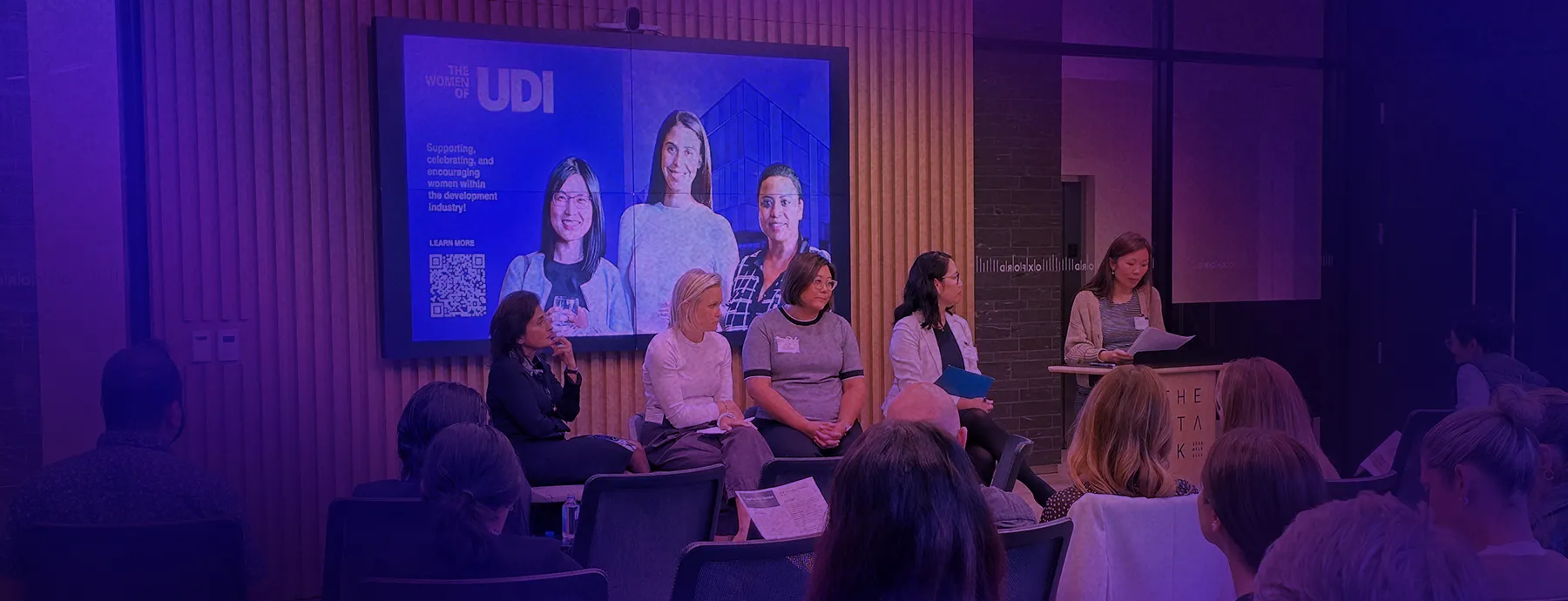
Against this backdrop, the Women of UDI recently brought together three industry leaders for Raising Capital in Today’s Market, presented by BlueCity Construction, to explore one of the most pressing questions facing the development industry today: where is capital still flowing, and what does it take to unlock it?
Moderated by Leslie Lai, Vice President Finance, Real Estate Markets at RBC, the panel featured:
• Shenoor Jadavji, Founder and President, Lotus Capital Corporation
• Kate Ayoubi, Executive Vice President, Financial Operations, Anthem Properties
• Lilian Chau, CEO, Entre Nous Femmes Housing Society
Representing private investment, development, and non-profit housing, the panelists brought distinctly different perspectives to the conversation. But a common theme emerged: despite current headwinds, uncertainty can create opportunity for organizations willing to innovate, diversify and rethink traditional approaches to capital.
Diversification and Geographic Agility
"You have to be resilient. You have to have hope. You have to understand the deal... my team calls it operational; I call it roll up your sleeves and get really dirty and get in there." — Shenoor Jadavji, Founder and President, Lotus Capital Corporation
When primary markets slow, geographic and asset diversity can become an important buffer, and the ability to adapt quickly becomes a competitive advantage.
For vertically integrated firms like Anthem Properties, maintaining operations across land development, ground-oriented housing, and income-producing properties across multiple regions creates opportunities to strategically pivot as market conditions evolve.
Kate Ayoubi shared that while British Columbia remains home, Anthem has capitalized on strong momentum in Alberta, particularly in land development and industrial assets, while planning for longer-term growth into the U.S. Southwest corridor.
Similarly, Shenoor Jadavji highlighted Lotus Capital’s strategy of looking beyond traditional gateway markets during downturns. By identifying defensive, cash-flow-driven assets such as grocery-anchored necessity retail and small-bay industrial in secondary and tertiary Canadian markets, Lotus has been able to match opportunities with the risk profiles and investment objectives of family offices and high-net-worth investors.
The discussion also pointed to emerging opportunities across sectors such as storage, seniors housing, data centers and industrial, where changing market conditions and significant infrastructure investment are helping drive new capital allocation.
The broader takeaway was not simply to go where conditions appear stronger. It was to understand the fundamentals of the deal, recognize where demand and opportunity are emerging, and remain agile enough to respond when market conditions change.
Social Finance and Innovative Instruments
"We don't treat affordable housing as basic social infrastructure. If you look at it as infrastructure, then perhaps there's a different way to finance that." — Lilian Chau, CEO, Entre Nous Femmes Housing Society
Some of the panel’s most thought-provoking dialogue came from the non-profit housing sector and the question of how organizations can rethink traditional funding models.
With government funding programs shifting and the need for affordable housing continuing to grow, Lilian Chau shared how Entre Nous Femmes Housing Society is moving toward a social enterprise model designed to support greater long-term financial sustainability.
To raise capital for new projects, including a 107-unit affordable housing development on Commercial Drive, the organization soft-launched the Together for Homes Affordable Housing Community Bond.
This debt instrument creates an opportunity for everyday community members, not only accredited investors, to invest directly in local housing infrastructure while earning a return and generating measurable social impact.
It also raises a broader question for the development industry: what becomes possible when we expand our thinking about who can provide capital, how that capital can be structured, and what it can accomplish?
For non-profit housing providers in particular, the conversation underscored the importance of building financial resilience beyond individual government funding programs. Organizations are also considering strategic acquisitions of newer, cash-flowing assets as a means of building equity reserves and supporting longer-term organizational sustainability.
While the financing structures may differ from those used by private developers, the underlying challenge is familiar across the industry: finding creative ways to align available capital with projects that need to move forward.
Creative Alignment with Investors
"One of the challenging pieces of the market... especially when working with institutional capital, is how de-risked the project has to be before they're willing to put money on the table, yet they still want the really high returns." — Kate Ayoubi, Executive Vice President, Financial Operations, Anthem Properties
Perhaps one of the clearest messages from the panel was that capital has not disappeared. Instead, the expectations attached to it have changed.
Capital providers, from institutional partners to private family offices, are demanding more de-risked structures, stronger fundamentals, and clearer paths to cash flow. For developers and investment partners, that makes understanding the needs and expectations of different sources of capital increasingly important.
Across the conversation, one message was clear: while today’s capital environment is more complex, opportunity remains. Moving projects forward requires creativity, adaptability and a willingness to rethink traditional approaches, whether that means exploring new markets, finding new sources of capital, or building partnerships around shared objectives.
For Women of UDI, conversations like these are an important opportunity to bring women from across the development industry together to share expertise, challenge conventional thinking and learn from one another. As the market continues to evolve, that exchange of ideas and perspectives will be increasingly valuable in navigating what comes next.
