


City of Surrey - 2026 Development Cost Charge Bylaw
Third Reading
At their meeting on May 11th, Council gave three readings to the 2026 Development Cost Charge Bylaw and directed staff to submit the bylaw to the Inspector of Municipalities for approval. The 2026 DCC Bylaw builds on work from 2025 by further simplifying the rate schedules. This includes:
- Transition to DCC rates based on building form, rather than zoning;
- Combination of Arterial and Collector Road DCCs to a Transportation DCC;
- Review and update of area specific DCC rates in City Centre, Anniedale-Tynehead, and Redwood Heights; and
- Harmonization of commercial DCC rates in Highway 99 to a per square foot rate that is consistent with the City-Wide DCC schedule.
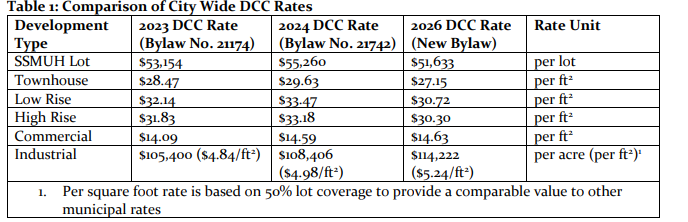
Additional information can be found in the full report by City staff.
July 28, 2025
As mentioned in previous updates, on July 28th Council gave three readings to the proposed 2025 Development Cost Charge (DCC) Bylaw and directed staff to forward the Bylaw to the Provincial Inspector of Municipalities for approval.
A 2025 DCC Bylaw was introduced by Council on March 10, 2025 and the third reading of the Bylaw was submitted to the Province for approval and the Province requested that the City make further changes to the Bylaw to better align with the governing legislation and their recently updated DCC best practices and guidelines. The comments from the Province allowed staff to further review current DCCs, population forecasts, and make additional recommendations to better address changes in the Zoning Bylaw and input from the development community.
Changes Made Based on Provincial Review
Bylaw Effective Date & Instream Period
The proposed Bylaw includes wording to align the Bylaw effective date with the date of final adoption granted by the City. Once this particular bylaw receives final adoption, the City will strive to update the bylaw rates at least bi-annually and seek future final adoptions to occur in January of any given year. Under the Local Government Act, any development applicant can opt to waive the in-stream protection period, so that if lower or more beneficial DCC fees are provided in an upcoming year, any in-stream development could choose request to utilize these fees regardless of in-stream protection.
Payment of DCCs
To meet the provisions of the Local Government Act, it was also necessary to amend Section 7 of the Bylaw such that a DCC must be paid at the time of the approval of the subdivision or the issue of the building permit, and not prior to approvals. The previous DCC Bylaw required payment before issuance of approvals or permits. The Province has recently announced that developers will now have the option to defer 75% of their DCCs, Amenity Cost Charges, and School-site Acquisition charges until occupancy or within four years, whichever comes first, following a permit approval.
Clarification for Small Scale Multi-Unit Housing
To support the application of DCCs on SSMUH developments, the Province recommended that additional language be added to clarify that this housing form / land-use (i.e., houseplex, duplex, garden suite, etc.) is required to pay DCCs.
City Centre Residential, Senior Apartments and Assisted Living
Following third reading of the March 2025 bylaw, members of the development industry contacted the City regarding concerns over the change in DCCs in City Centre, as well as the rates used for Senior Apartments and Assisted Living residences. Historically, the City implemented reduced impact ratios for high-rise apartments in City Centre, particularly transportation and parkland DCC components. The reduced impact ratios for transportation DCCs were attributed to proximity to rapid transit, resulting in less transportation impacts on municipal roads. The reduced impact ratios for parkland DCCs were attributed to proximity of a number of existing large parks around City Centre including Forsyth, Green Timbers, Hawthorne, Holland, Royal Kwantlen and Tom Binnie Parks that serve existing and future populations.
In 2004, Council approved reduced impact ratios for Seniors Apartments and Assisted Living Residences, where a lower impact ratio (approximately 66-70%) was used for Arterial, Collector and Parkland DCC components as compared to other residential rates. The proposed Bylaw remains consistent with previous Council direction.
Additional information can be found in the full report by City staff.
March 18, 2025
At their meeting on March 10th, Council gave three readings to the 2025 Development Cost Charge (DCC) Bylaw that includes the introduction of a Fire Services DCC and a “roll back” in residential DCCs to 2023 rates, representing a “freeze” in residential DCC’s in order for the City to apply for Canadian Housing Infrastructure Funding (CHIF).
In order to accommodate the changes required in the DCC Bylaw to accommodate Fire Services, to meet the criteria of the CHIF program, and deliver affordability to the residents of Surrey, the following key rate changes have been proposed:
- All residential DCCs (net totals) will be consistent with the 2023 DCC Bylaw rates;
- Fire Protection Services DCC is included for most building types, and DCC rates have been established based on a $56 million program over 10 years. These introductory DCCs have been offset by reductions in other DCC rates to result in “no net increase” for residential DCC’s up to May 2027;
- DCC rates for commercial, industrial, and institutional buildings have been held at the 2024 DCC rate, with no increase and further support collection of DCCs for residential development; and
- Area Specific DCCs have been held consistent with the 2023 rate schedules
Additional information can be found in the full report by City staff.
